
Cataracts cloud your eye's natural lens and add blur and glare to everyday life. Many people with cataracts are also juggling readers, another pair in the car, and progressives for everything in between.
At California LASIK & Eye, Dr. Bradley Barnett is the first surgeon in California, Nevada, and Oregon to offer the RayOne Galaxy™. He brings it to patients in Sacramento, Roseville, and Folsom. The goal is simple: keep your whole day in focus, from road signs to the menu in your hands.
Like every premium lens, the Galaxy suits some eyes better than others. We measure your eyes, learn how you spend your day, and recommend the lens that fits. Sometimes that is the Galaxy. Sometimes it is not, and we will tell you so.
- What Is the RayOne Galaxy Lens?
- Is the RayOne Galaxy a Trifocal Lens?
- Am I a Good Candidate for the RayOne Galaxy?
- What Happens at a RayOne Galaxy Consultation?
- Watch a RayOne Galaxy Procedure
- What Will My Vision Be Like After Surgery?
- Why Choose Dr. Bradley Barnett for Your Galaxy Lens?
- Frequently Asked Questions About the RayOne Galaxy
- What Do Patients Say About Dr. Barnett?
- See If the RayOne Galaxy Is Right for You
What Is the RayOne Galaxy Lens?
The RayOne Galaxy is one of the premium lens options we offer. Doctors call these lenses intraocular lenses, or IOLs. The Galaxy sits inside your eye permanently and takes over the focusing work your natural lens used to do.
Your natural lens starts to stiffen in your 40s, a condition called presbyopia. That is why reading up close gets harder. Later in life, the same lens can turn cloudy, which is a cataract. During cataract surgery, Dr. Barnett removes the cloudy lens and replaces it with the Galaxy. This restores clear vision and reduces your need for reading glasses.
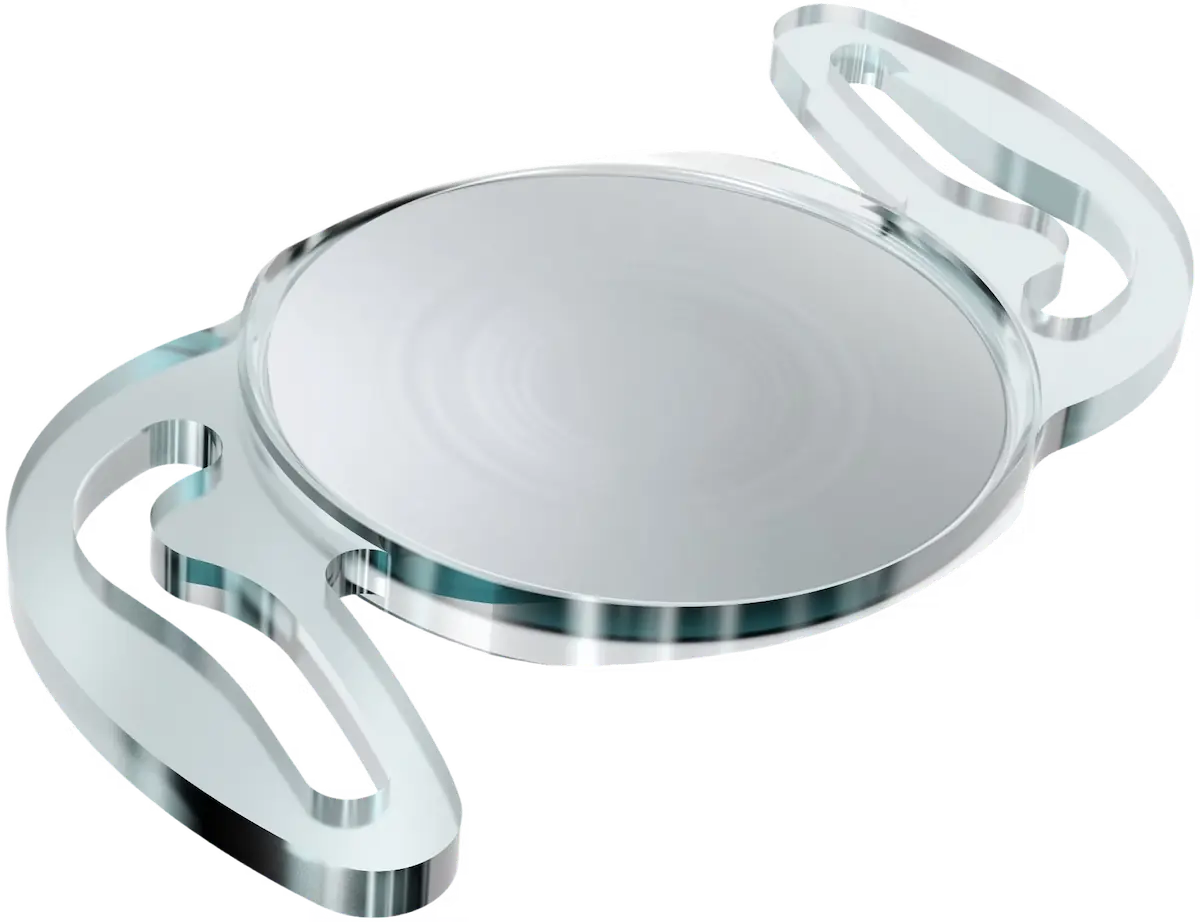
Cataract surgery is outpatient and takes about 15 to 20 minute per eye.. Dr. Barnett uses the Z8 neo femtosecond laser for key steps of the surgery. He is the first surgeon in California to use it. The laser makes a precise, round opening in the thin capsule that holds your lens, then softens the lens so it can be removed gently. Dr. Barnett then sets the Galaxy in its place.
What sets the Galaxy apart is a fine spiral pattern on its surface. Many multifocal lenses use rings that split light between two or three set distances. The Galaxy’s spiral changes the lens power gradually from the center outward, which creates one smooth range of focus. Rayner designed the spiral with artificial intelligence trained on patient outcomes.
The Galaxy is new to the United States, but not new to patients. The FDA approved the Galaxy and the Galaxy Toric, which reduces astigmatism, in September 2026. Approval followed a US study of more than 250 patients. Rayner reports more than 200,000 implants across 75 countries since 2024.
Am I a Good Candidate for the RayOne Galaxy?
Good candidates are adults having cataract surgery who want clear vision at every distance and have generally healthy eyes. You may be a strong candidate if you:
- Need cataract surgery and want to rely less on glasses afterward
- Are tired of switching between reading glasses and distance glasses
- Want to drive, use screens, and read without switching between pairs of glasses
- Have astigmatism, which the Galaxy Toric is designed to reduce

If the Galaxy is not the best fit for your eyes, Dr. Barnett will recommend a lens that is.
What Happens at a RayOne Galaxy Consultation?

Your consultation with Dr. Barnett starts with a conversation about your work, your hobbies, and the moments when glasses get in your way. Then we measure your eyes in detail. Your visit includes:
- Corneal mapping (topography) to check the shape of your eye’s front surface
- Precise eye measurements (biometry) to calculate your lens power
- Retina imaging (macular OCT) to confirm your retina is healthy
- A pupil assessment to plan for night vision
- A full eye surface and tear film evaluation
You leave with a lens recommendation built around your eyes and your priorities. We collect a $100 deposit at booking, and we apply it toward your surgery if you proceed.
Watch a RayOne Galaxy Procedure
Why Choose Dr. Bradley Barnett for Your Galaxy Lens?
Choosing the lens is half the decision. The surgeon who measures your eyes and places the lens is the other half.
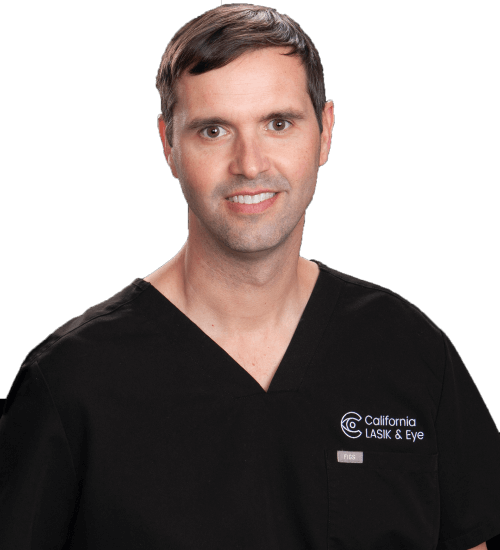
Dr. Bradley Barnett, MD, PhD, founded California LASIK & Eye and serves as its medical director. He earned his MD-PhD and completed his residency at Johns Hopkins. He then trained in cornea and refractive surgery at UC San Diego. He later served as an Assistant Professor at Duke University.
- First surgeon in California, Nevada, and Oregon to offer the RayOne Galaxy™
- First surgeon in California to use the Z8 neo femtosecond laser
- More than 25,900 procedures performed, with a 98.7% patient satisfaction rate
- 2025 Best Cataract Surgeons in America honoree
- 38 peer-reviewed publications, including in Nature Medicine and Science
His research speaks directly to lenses like the Galaxy. In his peer-reviewed review, Dr. Barnett compared the trade-offs between premium lens designs.
Credentials are only part of the picture. Patients tell us they never feel rushed or pressured here. Dr. Barnett explains every option in plain terms, answers every question, and builds your plan around how you live. He recommends only what he would choose for his own family.
Frequently Asked Questions About the RayOne Galaxy
Medicare and many insurance plans cover cataract surgery with a standard single-focus lens. They do not cover the upgrade to a premium lens like the Galaxy, so that portion is an out-of-pocket cost. Refractive lens exchange is elective, so insurance does not cover it. We offer transparent pricing and financing options, and we review your benefits at your visit.
Many patients drive during the day within a few days, once Dr. Barnett clears them at a follow-up visit. Night driving can take a little longer to feel natural.
Some patients notice faint halos around lights at first, mostly at night. Rayner designed the Galaxy’s spiral to minimize them. They tend to fade as your brain adjusts to your new lens.
Sometimes. Many patients do best with the Galaxy in both eyes. For others, Dr. Barnett may pair it with the TECNIS® PureSee™, a lens known for crisp distance and arm’s-length vision. PureSee goes in your dominant eye, the one you would use to peek through a keyhole. The Galaxy goes in the other eye to extend your reading range.
Possibly. LASIK and PRK change the shape of your cornea, which makes lens power calculations more complex. Dr. Barnett reviews detailed scans of your cornea and your original treatment records, when available, before recommending a lens.
Yes. The Galaxy stays in your eye for life and does not wear out or need replacing.
What Do Patients Say About Dr. Barnett?
“Perfect experience. Dr. Barnett and staff are helpful and nice. Was given lots of lens options and never pressured, just informed. I am very satisfied with my cataract surgery experience.” - Marcus B., Google Review ⭐⭐⭐⭐⭐
“Dr. Barnett was very knowledgeable and personable. He explained everything very well and even researched and looked into other issues I brought up during the appointment.” - Phil N., Google Review ⭐⭐⭐⭐⭐
“Doctor and assistant took time to explain everything with dates of surgery and follow-ups scheduled. Very professional.” - David W., Google Review ⭐⭐⭐⭐⭐
See If the RayOne Galaxy Is Right for You
Planning cataract surgery or ready to stop reaching for readers? The Galaxy may give you a full day of clear vision. Meet with Dr. Barnett at California LASIK & Eye to find out. We welcome patients from Sacramento, Roseville, and Folsom.
- American Academy of Ophthalmology. “What Is Presbyopia?” EyeSmart. https://www.aao.org/eye-health/diseases/what-is-presbyopia
- U.S. Food and Drug Administration. "Premarket Approval: RayOne Galaxy (RAO605G) and RayOne Galaxy Toric (RAO615X)." PMA P060011, Supplement S045. Decision date September 24, 2026. https://www.accessdata.fda.gov/scripts/cdrh/cfdocs/cfpma/pma.cfm?ID=P060011S045
- Abela-Formanek C, Amon M, Auffarth GU, et al. “Performance of the First Spiral Refractive Intraocular Lens for Continuous Full Range of Vision.” J Refract Surg. 2025;41(11):e1213-e1222. https://pubmed.ncbi.nlm.nih.gov/41212955/
- Rosa AM, Miranda AC, Patrício M, et al. “Functional Magnetic Resonance Imaging to Assess the Neurobehavioral Impact of Dysphotopsia with Multifocal Intraocular Lenses.” Ophthalmology. 2017;124(9):1280-1289. https://pubmed.ncbi.nlm.nih.gov/28433446/
- Barnett BP. “FOCUSED: Femtosecond Optimized Continuous Uncorrected Sight with EDOF and Diffractive Multifocal IOLs. A Review.” Curr Opin Ophthalmol. 2021;32(1):3-12. https://pubmed.ncbi.nlm.nih.gov/33122490/
