TECNIS PureSee:
The Refractive EDOF Lens for Continuous, Natural Vision
Enhanced vision through modern eye care
The TECNIS PureSee is a purely refractive extended depth of focus (EDOF) intraocular lens that extends your range of vision from distance through intermediate, with functional near. It is the first and only EDOF lens approved in the United States that carries no label warning for loss of contrast sensitivity. Dr. Bradley Barnett offers PureSee at California LASIK & Eye for cataract surgery and refractive lens exchange (RLE) across Sacramento, Roseville, and Folsom.
The human eye focuses light through a single, flexible crystalline lens sitting behind the iris. In youth, that lens changes shape thousands of times a day to move focus between distance, intermediate, and near. That mechanism, called accommodation, is a matter of biological precision, and it loses elasticity from your early forties onward, first with presbyopia and then eventually with cataract.
For decades the standard of care after cataract surgery has been the monofocal intraocular lens, or IOL. Monofocals restore clarity at one distance, usually distance vision, and readers or bifocals cover the rest. Monofocal outcomes are excellent, well-documented, and account for the vast majority of the roughly two million cataract surgeries performed in the U.S. every year. The science is well-established.
But the monofocal is no longer the most advanced option available, and at California LASIK & Eye we do not default patients to a lesser lens when a better one is clinically appropriate.
Extended depth of focus, or EDOF, was designed to elongate a single focal range instead of splitting light into separate focal points. The TECNIS PureSee is the latest generation of that idea: a purely refractive EDOF lens that extends a continuous range of vision without diffractive rings, while preserving contrast sensitivity comparable to a standard monofocal. Dr. Bradley Barnett offers PureSee at California LASIK & Eye in Sacramento, with the same standard of care extended to patients from Roseville, Folsom, and the greater Sacramento metro area.
Book a Consultation- Why EDOF, and Why Start There Instead?
- What Is the TECNIS PureSee IOL?
- Multifocal, Trifocal, and EDOF: A Comparison
- Am I a Candidate for the PureSee Lens?
- What to Expect: A Continuous, Natural Range of Vision
- Why California LASIK & Eye Is the Right Practice, and Meet Dr. Bradley Barnett
- Patient Reviews and Outcomes
- Frequently Asked Questions
- Schedule Your PureSee Consultation
Why Start With EDOF
Short answer: EDOF lenses extend your eye's focal range as a single continuous span, rather than splitting light into discrete near, intermediate, and distance points. That translates to more natural transitions between distances, generally fewer nighttime visual disturbances, and preserved contrast sensitivity compared with multifocal or trifocal designs.
The Three Distances Your Eye Focuses Across
Every conversation about IOLs starts with three distances. Distance is anything beyond about ten feet, from your toes to the horizon. Intermediate is roughly the length of your arm, where your computer screen, your kitchen counter, and your car dashboard sit. Near is closer, at the bend of your elbow, where reading a phone or a book happens. Reading glasses are typically set for near vision, which is why standard 2.00 diopter readers are the everyday benchmark most people already know. Your visual life happens across all three zones every day.
The Stack of Light Analogy
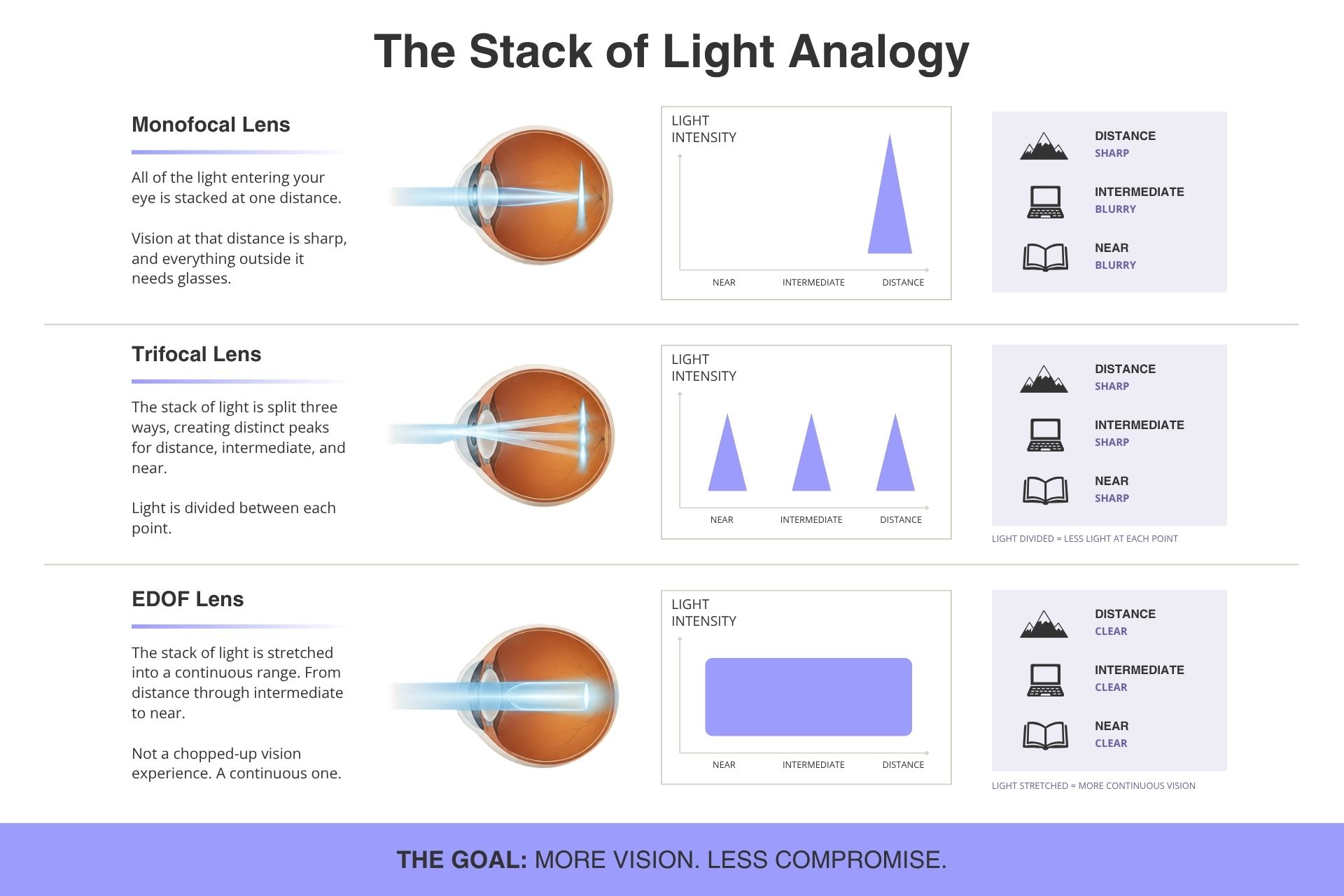
Dr. Barnett draws this for every patient. A monofocal lens takes all of the light entering your eye and stacks it at one distance. Vision at that distance is sharp, and everything outside it needs glasses. A trifocal lens splits that stack three ways, giving distinct peaks for distance, intermediate, and near, with light divided between each point. An EDOF lens takes the stack and stretches it into a continuous range from distance through intermediate to near.

Why EDOF Feels More Like Native Sight
Because EDOF stretches rather than splits, it tends to feel more like the vision you grew up with. It is generally more forgiving of small residual refractive error, and patients often adapt to it faster than they do to diffractive multifocal designs. Contrast sensitivity, the ability to distinguish an object from its background in dim or foggy conditions, is preserved close to the level of a standard aspheric monofocal.
A Purely Refractive Design
Older EDOF lenses used diffractive rings to split light into an elongated focal range. That approach broadened vision, but often introduced halos, glare, and reduced contrast, especially in low light. PureSee uses a continuously varying refractive surface instead of concentric rings, which achieves the extended range without the optical trade-offs typical of diffractive designs.
Contrast Sensitivity Comparable to a Monofocal
In head-to-head randomized studies, PureSee delivered corrected distance visual acuity comparable to an enhanced monofocal lens, while providing statistically superior intermediate and near visual acuity. Mesopic contrast sensitivity fell within 0.11 log units across all measured spatial frequencies, an outcome consistent with a standard aspheric monofocal. That is the finding underpinning the FDA label distinction.
A Broader Depth of Focus With a Longer Tail
Clinical bench and defocus curve analyses show PureSee maintains functional visual acuity better than 0.2 logMAR (roughly 20/32 or better) from distance through approximately negative two diopters of defocus, which corresponds to about 50 centimeters, or well within intermediate range. Published defocus curve data support this range. In post-approval prospective data from an independent European cohort, 83% of patients were fully satisfied and 96% said they would repeat the surgery with the same lens at three months.
FDA-Approved on March 12, 2026
The PureSee (model ZEN00V) and its astigmatism-correcting version, PureSee Toric II, received U.S. FDA approval on that date. Prior to U.S. approval, nearly half a million eyes had been treated with PureSee globally.
Every IOL category involves trade-offs. Here is how the three main premium categories differ in mechanism and in what patients typically experience.
Comparing Premium IOL Types
How diffractive multifocals, enhanced monofocals, and the EDOF TECNIS PureSee lens differ across the priorities that matter most.
| Multifocal / Trifocal | Enhanced Monofocal | EDOF – TECNIS PureSee | |
|---|---|---|---|
| Optical design | Diffractive rings split light into two or three separate focal points | A single focal point with slightly extended depth of focus | A refractive surface extends one continuous focal range, with no diffractive rings |
| Range of clear vision | Distinct peaks at distance, intermediate, and near | Distance, with modest intermediate | Distance through intermediate, with functional near |
| Contrast sensitivity | Can be reduced, especially at night | Preserved | Preserved, comparable to a monofocal |
| Nighttime halos and glare | More common (halos, starbursts) | Minimal | Typically a lower incidence |
| Near-vision spectacle independence | Highest; trifocals give the best uncorrected near | Limited | Strong intermediate and functional near; readers occasionally for fine print |
| Tolerance of residual refractive error | Less forgiving | Forgiving | More forgiving |
| Best-fit patient | Wants maximum glasses-free near and accepts some halos | Prioritizes distance and contrast, comfortable using readers | Wants a natural, continuous range with monofocal-like contrast |
Individual results vary. The right lens depends on your eyes, your visual priorities, and a full preoperative evaluation with Dr. Barnett.
Multifocal and trifocal IOLs use diffractive optics to create two or three separate focal points, one each for distance, intermediate, and (for trifocals) near. This approach can maximize spectacle independence, and network meta-analyses of randomized trials show trifocals often deliver the best uncorrected near acuity of any presbyopia-correcting design. Because the incoming light is divided across focal points, some patients notice halos, starbursts, or a reduction in contrast, particularly at night. Diffractive designs may also be less forgiving in eyes with dry eye, macular pathology, or higher-order corneal aberrations, which is why patient selection matters more with these lenses.
Enhanced monofocal IOLs slightly extend the depth of focus of a traditional monofocal without splitting light. They preserve distance vision and contrast, but the intermediate and near range they provide is modest.
EDOF lenses like the TECNIS PureSee extend a single continuous focal range from distance through intermediate, with functional near. They preserve contrast sensitivity comparable to a monofocal and typically show a lower incidence of bothersome halos or glare. They are generally more forgiving of residual refractive error, which supports patient tolerance of small post-op astigmatism or nearsightedness.
There is no single best lens for every eye. The right choice depends on your visual priorities, your ocular anatomy, your ocular surface health, and whether you are willing to trade off some near-vision spectacle independence for a more monofocal-like contrast profile. Dr. Barnett will discuss all of these categories with you before recommending a lens. For some patients, he may pair PureSee in one eye with the RayOne Galaxy™ spiral lens in the other, which reaches further into near vision. Dr. Barnett reviewed the evidence across these lens categories in his peer-reviewed paper, FOCUSED: Femtosecond Optimized Continuous Uncorrected Sight with EDOF and Diffractive Multifocal IOLs, published in Current Opinion in Ophthalmology.
Am I a Candidate for the PureSee Lens?
Short answer: Most adults undergoing cataract surgery or refractive lens exchange with less than one diopter of preoperative corneal astigmatism are candidates for the standard PureSee. Patients with one or more diopters of corneal astigmatism may be candidates for the PureSee Toric II. Final eligibility depends on a full preoperative workup.
The best candidates for PureSee tend to share several traits:
- Adults 45 and older with cataracts or presbyopia who value a natural, continuous range of vision.
- Patients who work at a computer, drive frequently, or want strong intermediate vision without noticeable halos.
- Patients who prioritize contrast sensitivity and image quality over maximum near-vision spectacle independence.
- Patients with a healthy ocular surface, or with dry eye that has been optimized before surgery (we screen every patient for STODS and the ocular surface before recommending a premium IOL).
- Patients without significant macular disease, uncontrolled glaucoma, or corneal irregularities that would compromise any premium IOL.
PureSee is not indicated for patients under age 22 or for pregnant patients, and Dr. Barnett weighs candidacy carefully in eyes with pre-existing ocular conditions, prior refractive surgery, or intraoperative complications. Your preoperative evaluation at California LASIK & Eye includes corneal topography, biometry, macular OCT imaging, and a full ocular surface assessment. If PureSee is not the right lens for your eye, we will say so, and we will recommend one that is.
What to Expect: A Continuous, Natural Range of Vision
Short answer: Most PureSee patients experience a natural, continuous range of vision from distance through intermediate, with functional near. Reading glasses may still be needed occasionally for very small print or demanding near tasks. Results vary by patient, and are confirmed at your consultation.

Dr. Barnett implants PureSee during standard phacoemulsification cataract surgery or refractive lens exchange, both outpatient procedures typically lasting 15 to 20 minutes per eye. Vision improves rapidly for most patients, with continued stabilization over the first several weeks. Final visual outcome is generally assessed one to three months postoperatively.
Because PureSee produces a longer, smoother depth of focus (what the clinical literature calls a "longer tail" in defocus curve terms), there is often less blending needed between the two eyes, and the non-dominant eye can still see well at distance. That matters, because it lets you use both eyes for both zones of vision, which is closer to how your eyes worked before presbyopia and cataract set in. Some patients still choose readers for fine print or dim reading. That is normal, and we set that expectation up front. In the pivotal study, 97% of patients reported no very bothersome visual disturbances, and 97% said they would recommend the lens to friends or family.
Why California LASIK & Eye Is the Right Practice, and Meet Dr. Bradley Barnett

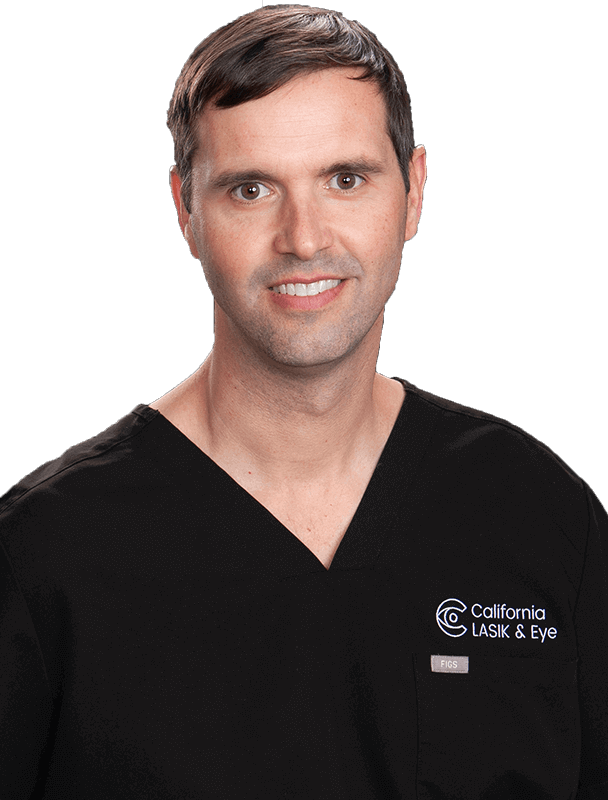
Choosing the right IOL is only half of the equation. The surgeon and practice implanting the lens matter just as much. Dr. Bradley Barnett, MD, PhD, is the founder and medical director of California LASIK & Eye. He completed his MD-PhD at the Johns Hopkins School of Medicine in pharmacology, followed by ophthalmology residency at the Johns Hopkins Wilmer Eye Institute and a cornea and refractive surgery fellowship at the UCSD Shiley Eye Institute. He previously served as an Assistant Professor at Duke University in the Cornea and Refractive Surgery Division, and as Medical Director at NVISION Eye Centers.
Dr. Barnett has performed more than 25,900 procedures, with a 98.7% patient satisfaction rate and a 99.2% LASIK success rate at the 20/20 or better mark. He is the highest-volume EVO ICL surgeon in the greater Sacramento area (per the official ICL Doctor Finder), and was the first ophthalmologist in California, and among the first ten in the United States, to offer WaveLight Plus Ray Trace LASIK. He has 38 peer-reviewed publications, including in Nature Medicine and Science, and five granted patents in medical device innovation. He authored the peer-reviewed review FOCUSED in Current Opinion in Ophthalmology and co-authored the paper defining STODS in Diagnostics. He was named a 2025 Best Cataract Surgeons in America honoree, and was published in Surgery Business Magazine in January 2026.
That academic background matters here because premium IOL selection is not a matter of picking a brand off a shelf. It is a matter of matching a specific lens design to a specific eye, based on corneal shape, pupil behavior, macular health, and lifestyle. Dr. Barnett approaches PureSee the same way he approaches every IOL choice: with evidence-based comparison, honest expectation-setting, and a clear "no" when a lens is not the right fit.
Patient Reviews and Outcomes
Real patient stories and verified reviews live at the center of how California LASIK & Eye earns your trust. Below we feature named reviews from patients treated at our Sacramento practice.
Frequently Asked Questions
The TECNIS PureSee IOL is a purely refractive extended depth of focus (EDOF) intraocular lens that extends your range of clear vision from distance through intermediate, with functional near, while preserving contrast sensitivity comparable to a standard monofocal lens.
PureSee uses a refractive optical profile that extends a single continuous focal range, while multifocals and trifocals use diffractive rings to create two or three separate focal points by splitting incoming light. As a result, PureSee generally produces fewer bothersome halos or glare and preserves contrast sensitivity comparable to a monofocal, at the cost of somewhat less near-vision independence than a trifocal design.
Most patients rely on glasses far less after PureSee, and many go without them for distance and intermediate tasks. Reading glasses may still be needed occasionally for very small print or extended near work. Results vary, and we set specific expectations for your eyes at your consultation.
Yes. Dr. Bradley Barnett performs PureSee cataract surgery and refractive lens exchange at California LASIK & Eye's Sacramento location, and serves patients from Roseville, Folsom, Elk Grove, Davis, and the greater Sacramento metro area.
Yes. The companion TECNIS PureSee Toric II lens is indicated for patients with one diopter or more of preoperative corneal astigmatism. Dr. Barnett will determine astigmatism magnitude with corneal topography and biometry during your workup.
Most PureSee patients notice improved vision within days of surgery, with continued stabilization over the following weeks. Final visual outcome is typically assessed one to three months postoperatively. Recovery involves prescription eye drops for several weeks and follow-up visits at approximately one day, one week, and one month after surgery.
Patients with significant macular disease, uncontrolled glaucoma, severe corneal irregularities, or an unmanaged ocular surface are typically not ideal PureSee candidates. Every candidacy determination is made after a full preoperative evaluation. If PureSee is not right for your eye, Dr. Barnett will recommend a lens that is.
Schedule Your PureSee Consultation
If you are considering cataract surgery or refractive lens exchange in Sacramento, Roseville, or Folsom, the next step is a consultation with Dr. Barnett to determine whether the TECNIS PureSee is the right lens for your eye and your lifestyle.
Your consultation includes corneal topography, biometry, macular imaging, and a full ocular surface assessment, followed by a lens recommendation grounded in your specific anatomy and visual priorities. A $100 deposit is collected at booking, and is applied toward your surgery if you proceed.
Book a Consultation
Your consultation is with Dr. Bradley Barnett at California LASIK & Eye, serving Sacramento, Roseville, Folsom, Elk Grove, Davis, and the greater Sacramento metro area.
Book Online1. American Academy of Ophthalmology. "What Is Presbyopia?" AAO EyeSmart. <https://www.aao.org/eye-health/diseases/what-is-presbyopia>. Supports: presbyopia mechanism (lens rigidity with age).
2. National Academies of Sciences, Engineering, and Medicine (NEI). "Understanding the Epidemiology of Vision Loss and Impairment in the United States." NCBI Bookshelf NBK402366. <https://www.ncbi.nlm.nih.gov/books/NBK402366/>. Supports: U.S. cataract surgery volume and cataract prevalence context.
3. Corbett D, Black D, Roberts TV, et al. "Quality of vision clinical outcomes for a new fully-refractive extended depth of focus intraocular lens." Eye (Lond). 2024;38(Suppl 1):9-14. DOI: 10.1038/s41433-024-03039-8 (PMID 38580741). Supports: PureSee superior intermediate/near acuity vs enhanced monofocal (DCIVA 0.13 vs 0.18 logMAR, p=0.0127; DCNVA 0.37 vs 0.43 logMAR, p=0.0137); mesopic CS within 0.11 log units of monofocal.
4. Alarcon A, Del Aguila Carrasco A, Gounou F, et al. "Optical and clinical simulated performance of a new refractive extended depth of focus intraocular lens." Eye (Lond). 2024;38(Suppl 1):4-8. DOI: 10.1038/s41433-024-03041-0 (PMID 38580743). Supports: refractive (non-diffractive) design mechanism; comparable dysphotopsia profile to monofocal.
5. Alfonso-Bartolozzi B, Martinez-Alberquilla I, Fernández-Vega-Cueto L, et al. "Optical and Visual Outcomes of a New Refractive Extended Depth of Focus Intraocular Lens." J Refract Surg. 2025;41(4):e333-e341. DOI: 10.3928/1081597X-20250221-02 (PMID 40197065). Supports: depth of focus from +1.00 to -2.00 D (~50 cm) with VA better than 0.2 logMAR; power profile analysis.
6. Black DA, Bala C, Alarcon A, Vilupuru S. "Tolerance to refractive error with a new extended depth of focus intraocular lens." Eye (Lond). 2024;38(Suppl 1):15-20. DOI: 10.1038/s41433-024-03040-1 (PMID 38580742). Supports: PureSee tolerance to residual refractive error including small post-op astigmatism/myopia.
7. Johnson & Johnson. "Johnson & Johnson Announces FDA Approval of TECNIS PureSee Intraocular Lens." Press release, March 12, 2026. <jnj.com press release>. Supports: FDA approval date March 12, 2026; 97% no very bothersome visual disturbances; 97% would recommend; ~500,000 eyes treated globally.
8. Cho JY, Won YK, Park J, et al. "Visual Outcomes and Optical Quality of Accommodative, Multifocal, Extended Depth-of-Focus, and Monofocal Intraocular Lenses in Presbyopia-Correcting Cataract Surgery: A Systematic Review and Bayesian Network Meta-analysis." JAMA Ophthalmol. 2022;140(11):1045-1053. DOI: 10.1001/jamaophthalmol.2022.3667 (PMID 36136323). Supports: trifocal near-vision advantage; multifocal vs EDOF vs monofocal comparison.
9. J&J Vision Professional. "TECNIS PureSee IOL — Indications and Important Safety Information." <https://www.jnjvisionpro.com/en-us/products/tecnis-puresee/>. Supports: astigmatism indication for Toric II; candidacy exclusions (age <22, pregnancy, pre-existing conditions).
10. Kohnen T et al. "Clinical Performance After Implantation of a New Purely Refractive Extended Depth of Field Intraocular Lens in Cataract Patients." PMC13025765. Post-approval prospective study. <https://pmc.ncbi.nlm.nih.gov/articles/PMC13025765/> Supports: 83% fully satisfied at 3 months, 96% would repeat surgery. NOTE for editor: small European cohort (n=29 patients, 58 eyes); frame as supportive post-market data, not U.S. pivotal evidence.
11. Barnett BP. "FOCUSED: Femtosecond Optimized Continuous Uncorrected Sight with EDOF and Diffractive Multifocal IOLs — A Review." Curr Opin Ophthalmol. 2021;32(1):3-12. doi:10.1097/ICU.0000000000000723 (PMID 33122490). Supports: peer-reviewed review of EDOF vs diffractive multifocal IOL mechanisms and outcomes; authored by Dr. Barnett.
12. Hirabayashi MT, Barnett BP. "Solving STODS — Surgical Temporary Ocular Discomfort Syndrome." Diagnostics (Basel). 2023;13(5):837. doi:10.3390/diagnostics13050837 (PMID 36899981). Open access, CC BY 4.0. Supports: definition of STODS; co-authored by Dr. Barnett.