
Dr. Barnett’s FOCUSED Review: Sharper Vision at Every Distance After Cataract Surgery
Can laser cataract surgery help you see clearly at every distance? It can, especially if you choose a premium lens designed to reduce your need for glasses. These lenses work best when almost no astigmatism remains after surgery. A laser can correct astigmatism more precisely than a surgeon’s hand. Dr. Bradley Barnett explains why in his published review, and what it means for his patients in Sacramento, Roseville, and Folsom.
What This Study Is About
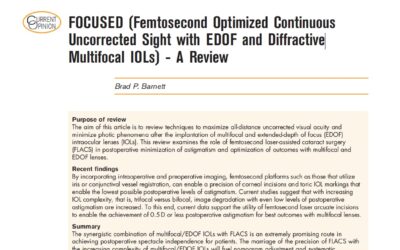
Dr. Barnett completed his ophthalmology residency at the Johns Hopkins Wilmer Eye Institute. He then trained in cornea and refractive surgery at the UCSD Shiley Eye Institute. His published review appeared in Current Opinion in Ophthalmology in January 2021.
The review tackles a common frustration with premium lens implants. These lenses can reduce your need for glasses after cataract surgery or refractive lens exchange. Some patients, though, notice halos around lights, glare, or less crisp vision afterward. Dr. Barnett set out to explain why, and what surgeons can do about it.
His answer centers on astigmatism. When a laser corrects it during surgery, premium lenses can deliver the clear vision they promise. Dr. Barnett calls this approach FOCUSED, a name that combines the laser and the lenses it helps.
What Is a Premium Lens Implant?
Cataract surgery replaces the cloudy lens inside your eye with a clear artificial lens. A standard lens focuses at one distance, usually far away. Many people with a standard lens still wear glasses for reading or other close-up tasks.
Premium lenses give you clear vision at more than one distance. They come in a few main types:
- Multifocal lenses divide light into separate focus points. Some cover far and near vision. Others, called trifocals, add a middle range for things like a computer screen or a car dashboard.
- Extended depth of focus (EDOF) lenses stretch focus into one smooth range from far to middle distances. They tend to cause fewer halos and less glare, but they don’t help as much with close reading.
Each type involves trade-offs. Some patients see halos around lights at night, glare, or slightly softer vision. Dr. Barnett’s review shows that leftover astigmatism makes these effects worse.
What Is Astigmatism, and Why Does It Matter With Premium Lenses?
Astigmatism means the front of your eye curves more like a football than a basketball. Light focuses unevenly, so vision looks blurry or stretched. It is common. About two in three people having cataract surgery have a mild amount.
Premium lenses are more sensitive to astigmatism than standard lenses. Because they spread light across more than one distance, even a small amount can blur your vision near and far.
The more advanced the lens, the more this matters. Studies in the review found trifocal lenses lost the most sharpness when astigmatism remained. Patients with trifocals also reported the biggest drop in satisfaction. For the best results with these lenses, Dr. Barnett recommends correcting astigmatism until almost none is left.
How Does Laser Cataract Surgery Correct Astigmatism?
Getting astigmatism that close to zero by hand is difficult. Surgeons have long corrected it with small incisions and markings made by hand. Slight variations in placement can leave some astigmatism behind. As a result, many cataract patients still have some after surgery.
Laser cataract surgery uses a specialized laser, called a femtosecond laser, guided by detailed images of your eye. For many routine steps of cataract surgery, the laser performs about the same as a skilled surgeon. Correcting astigmatism is where the laser clearly does better.
The laser helps in three ways:
- Precise corneal incisions: the laser makes tiny curved openings that help round out the front of your eye. It places each one at an exact depth, length, and position.
- Accurate lens positioning: some premium lenses correct astigmatism themselves, but only when they sit at exactly the right angle. The laser marks that angle so your surgeon can line the lens up precisely.
- A personalized map: the laser maps your eye during surgery and matches it to your earlier measurements. It uses the unique pattern of your iris, the colored part of your eye, like a fingerprint.
That precision matters. Even a few degrees off target weakens the correction and can create new blur. In one study, laser surgery with careful planning left 95% of eyes with almost no astigmatism.
What Comes Next for Premium Lenses?
Adjusting your vision after surgery is already possible today. The Light Adjustable Lens™ lets Dr. Barnett fine-tune your prescription after your eye heals, using in-office light treatments. You see your real-world results before your final prescription is set.
Dr. Barnett’s review looks even further ahead. Early research suggests lasers may one day adjust other premium lenses after surgery. That could make touch-ups possible and allow vision customized to each individual eye.
What Does This Mean for Your Lens Choice?
Choosing a premium lens is a personal decision. Your daily activities, your eye health, and your expectations all matter. Dr. Barnett’s review shows the lens itself is only half the equation. How precisely your surgeon corrects astigmatism shapes how well that lens performs.
During your consultation, Dr. Barnett reviews your measurements with you. He explains which lens types fit your eyes and lifestyle, and you decide together. We recommend only what is right for you, even if that means a standard lens.
The Bottom Line
Premium lenses can reduce your need for glasses after cataract surgery or refractive lens exchange. How well they work depends heavily on how much astigmatism remains. Dr. Barnett’s review makes the case that laser cataract surgery offers some of the most precise astigmatism correction available. That precision gives premium lenses their best chance to deliver.
Considering cataract surgery or a premium lens in Sacramento, Roseville, or Folsom? The same precision behind this research guides how we plan your procedure. Dr. Barnett is a 2025 Best Cataract Surgeons in America honoree. He uses our advanced diagnostic technology to build your plan on accurate measurements from the start.
Contact California LASIK & Eye to book a consultation with Dr. Barnett. A $100 deposit reserves your visit and applies toward surgery if you move forward. Get Out of Glasses TODAY™.
Source Index
Barnett BP. FOCUSED (Femtosecond Optimized Continuous Uncorrected Sight with EDOF and Diffractive Multifocal IOLs) – A Review. Current Opinion in Ophthalmology. 2021;32(1):3-12. doi:10.1097/ICU.0000000000000723.